
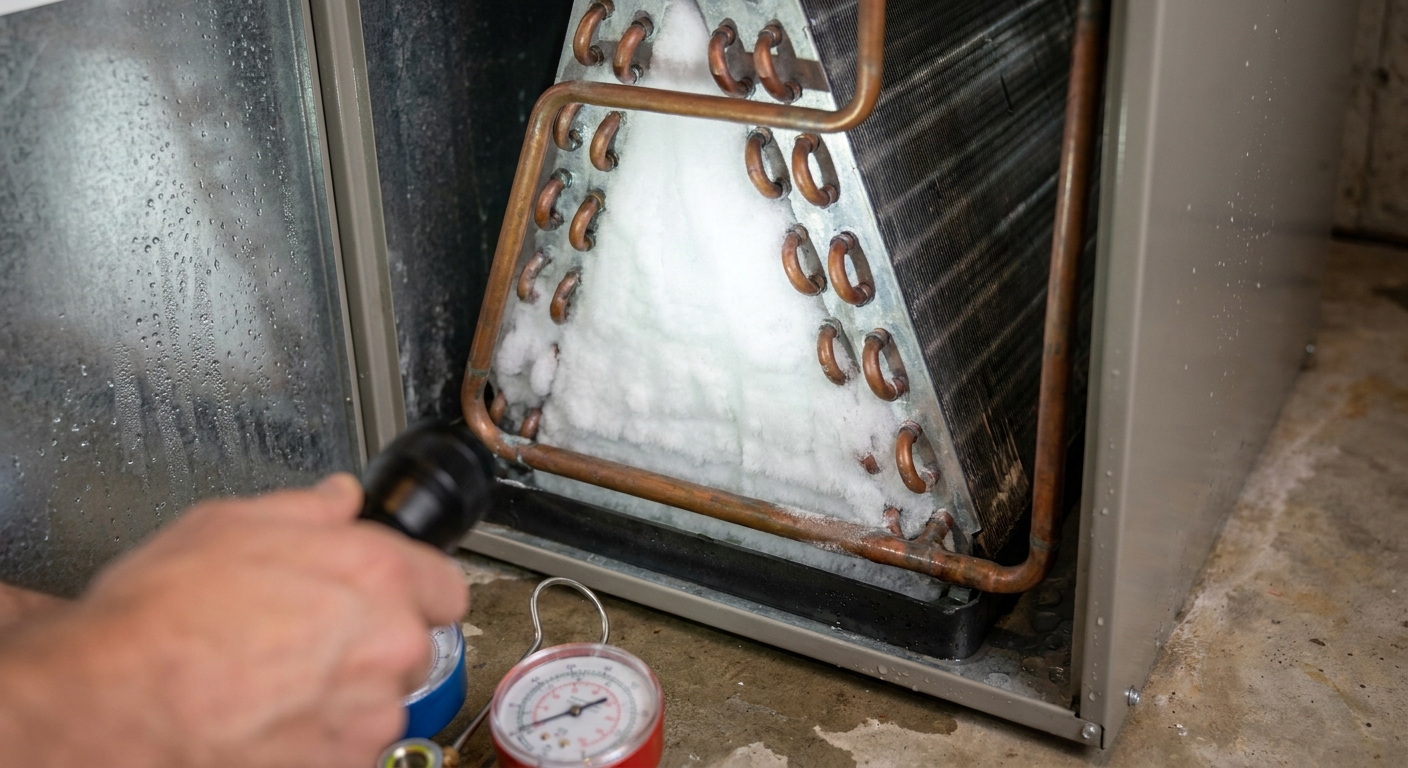
A frozen evaporator coil almost always means airflow or refrigerant is restricted somewhere in the system, and running the AC through it for even a few more hours can crack the compressor. This guide walks through why coils freeze, the steps to thaw and fix one safely, and when to stop DIY and call a Carrier-authorized contractor like Fresh Air Flow.
- AC coils freeze when warm airflow across the coil drops too low, usually from a dirty filter or low refrigerant.
- Turn the system off at the thermostat first — running a frozen coil risks compressor damage costing thousands in 2026.
- A full thaw takes 1 to 3 hours with the fan running; never chip ice off the coil.
- If ice returns within 48 hours after a proper thaw, the cause is refrigerant loss or a duct restriction, not the filter.
- Cherry Hill homeowners with a frozen coil after a filter change should still schedule a refrigerant check before the next heat wave.
Why this matters
A frozen coil isn't a cosmetic problem — it's a symptom. The evaporator coil needs a steady flow of warm indoor air passing over it to absorb heat and keep refrigerant at the right temperature. Cut that airflow, or drop the refrigerant charge, and the coil surface temperature falls below 32°F, and moisture in the air turns to ice on contact.
Once ice builds up, it insulates the coil and blocks airflow even further, so the problem compounds fast. Left running, a frozen coil sends liquid refrigerant back to the compressor instead of vapor — that's the failure mode that turns a $200 filter fix into a $2,500 compressor replacement in 2026. Catching it in the first hour saves the equipment.
What you'll need
- A step ladder (if the air handler or coil access panel is overhead)
- A screwdriver or nut driver for the access panel
- A flashlight
- A fresh 1-inch or 4-inch air filter (correct size for your system)
- A wet/dry shop vacuum
- A soft-bristle brush and no-rinse coil cleaner
- Towels and a bucket for the thaw
- 1 to 3 hours of downtime for the system
The steps
1. Turn off the system immediately
Switch the thermostat to "off," not just "fan." Continuing to run the compressor against a blocked, icy coil is the single most common cause of a burned-out compressor in frozen-coil calls. Leave the indoor blower fan running on its own if your thermostat allows a fan-only mode — that airflow speeds up the thaw.
Common mistake: People switch to "fan only" but leave cooling mode armed, so the compressor cycles back on the moment the coil sensor allows it. Kill the whole system at the thermostat, not just the compressor call.
2. Locate and inspect the evaporator coil
The evaporator coil sits inside the air handler cabinet, usually in the attic, basement, or a closet, downstream of the blower. Remove the access panel and look for visible ice, frost, or condensation pooling below the coil. Note whether the ice is a thin frost layer or a solid block — a solid block means this has been building for days, not hours.
3. Check the air filter
Pull the filter and hold it up to a light. If you can't see light through it, it's restricting airflow enough to freeze a coil on its own. A filter clogged with pet hair or dust cuts airflow by 30% or more in typical residential systems, which is often enough to push coil temperature below freezing on a mild day.
Replace it with the correct size — don't reuse a washable filter that hasn't been cleaned in the last 60-90 days.
4. Inspect the blower and return vents
Walk the house and check every return air grille for furniture, rugs, or curtains blocking it. A single closed or blocked return can starve the coil of the volume of air it needs. Also check that the blower wheel itself isn't caked in dust — a dirty blower wheel can lose 20% of its rated airflow even with a clean filter.
Common mistake: Closing supply vents in unused rooms to "save energy." Closing more than 2-3 vents on a system sized for the whole house reduces total airflow and raises freeze risk.
5. Let the coil thaw completely
With the system off and the blower running (or fan-only mode), let the ice melt on its own — expect 1 to 3 hours depending on how much ice built up. Place towels and a bucket under the air handler to catch runoff, and check the condensate drain pan isn't already overflowing from a clogged line.
Never use a knife, hairdryer, or heat gun to speed this up. Coil fins are thin aluminum and puncture or bend easily, and a punctured coil means a full replacement instead of a repair.
6. Check refrigerant charge and look for leaks
Low refrigerant is the second most common cause of coil freezing after airflow restriction, and it's the one DIY can't fix. Signs of low charge include hissing sounds near the line set, oily residue at joints, or ice that returns within 24-48 hours of a clean thaw with a new filter. Diagnosing and recharging refrigerant requires EPA certification and gauges — this is the point to call an HVAC contractor rather than keep guessing.
7. Clean the coil and drain line
Once fully thawed and dry, use a soft brush and no-rinse coil cleaner on the fins, working in the direction of the fins (never across them) to avoid bending them. Flush the condensate drain line with a wet/dry vacuum from the outdoor termination point to clear any algae or sludge blocking drainage — a clogged drain line is a frequent secondary cause of moisture buildup that contributes to freezing.
8. Restart and monitor
Replace the access panel, restore the thermostat to cooling mode, and run the system for a full 2-hour cycle while checking supply vent temperatures. A properly running AC should deliver air 15-20°F cooler than the return air temperature. If the coil frosts again within that first cycle, stop the system and schedule a professional diagnostic before running it further.
Troubleshooting
- Ice comes back within a day after replacing the filter — refrigerant is low or there's a leak; this needs a licensed technician with gauges, not another filter change.
- Coil freezes only on the hottest days — the system may be undersized or the ductwork is restricting airflow at peak demand; a duct static pressure test will confirm it.
- Water is leaking from the air handler, not just the coil area — the condensate drain line is clogged or the drain pan has rusted through; both need attention before you restart the AC.
- Blower runs but barely any air comes from vents — check for a collapsed flex duct section or a closed damper in the trunk line, common in homes built before 2010 with older duct systems.
- System short-cycles (on/off every few minutes) after the thaw — this points to a failing thermostat sensor or a refrigerant issue, not airflow, and warrants a service call.
- Coil looks clean and dry but freezes again within hours — suspect a stuck or miswired reversing valve on heat pump systems, which needs a technician's diagnostic tools.
Tools and resources
- A correctly sized 1-inch or 4-inch filter, replaced every 60-90 days during cooling season
- A wet/dry vacuum for drain line clearing
- A soft-bristle coil brush and no-rinse cleaner rated for aluminum fins
- A basic infrared or probe thermometer to check supply vs. return temperature differential
- An HVAC contractor with EPA 608 certification for any refrigerant work — this isn't optional once low charge is suspected
Coil keeps freezing? Get it diagnosed
Fresh Air Flow checks refrigerant, airflow, and ductwork on Cherry Hill area systems.
What to do next
If the coil stays clear for a full cooling cycle after a filter change and thaw, the fix likely held. If it freezes again, the cause is mechanical — low refrigerant, a failing blower motor, or a duct restriction — and none of those are safe or legal to diagnose without proper tools. Book a seasonal tune-up before summer 2026 peaks; catching a slow refrigerant leak in spring costs far less than an emergency call in August.
FAQ
Why do AC coils freeze?
AC coils freeze when airflow across the evaporator coil drops too low or refrigerant charge is low, dropping coil surface temperature below 32°F. A dirty filter is the most common cause, followed by low refrigerant and blocked return vents.
How long does it take for a frozen AC coil to thaw?
A frozen coil typically thaws in 1 to 3 hours with the system off and the blower fan running. Larger ice buildups from days of running through the freeze can take longer.
Can I run my AC with a frozen coil?
No, running the AC with a frozen coil risks sending liquid refrigerant back to the compressor, which can cause permanent damage. Turn the thermostat fully off until the coil thaws and the underlying cause is fixed.
Is a frozen AC coil an emergency?
It's not a life-safety emergency, but it needs same-day attention. Continued operation risks compressor failure, which turns a filter or refrigerant fix into a full system replacement.
What does it mean if my AC coil keeps freezing after I fix the filter?
Recurring freezing after a filter change points to low refrigerant, a duct restriction, or a failing blower motor. These need a licensed HVAC technician with gauges and static pressure tools to diagnose.
How much does it cost to fix a frozen AC coil?
A simple filter and airflow fix costs little beyond a new filter, but a refrigerant leak repair or coil replacement runs into the hundreds to low thousands depending on the cause. A diagnostic visit narrows down which repair you actually need.
Can low refrigerant cause a coil to freeze?
Yes, low refrigerant is the second leading cause of coil freezing after airflow restriction. It drops pressure and temperature inside the coil low enough to freeze condensation on the surface.
Should I use a hairdryer to thaw a frozen AC coil faster?
No, direct heat can warp or puncture the thin aluminum fins on the coil. Let it thaw naturally with the blower fan running instead.
One last thing
A fully iced evaporator coil can add 15-20 pounds of frozen water weight to the air handler, enough in older installations to strain the coil's mounting brackets over repeated freeze cycles. If your system has frozen more than once in the same cooling season, that's not bad luck — it's a sign the underlying airflow or refrigerant issue never actually got fixed the first time.